Grace Next Door

Exploring Faith Together

  • We live in a world that is constantly pulling at our attention. Screens, shows, streaming platforms, endless feeds…it’s always something. And listen, imagination itself isn’t the problem. God gave us imagination. It’s how we dream up new ideas, create things, and even picture what He might do in our future.

    But here’s the danger: imagination can get twisted. Instead of helping us dream with God, it can become a way to check out. A way to live in “what if” instead of “what is.” The Bible calls that vain imagination.

    And if we’re being honest, we’ve all gone there. Maybe you’ve thought:

    What if I had a different job? What if I had married that other person? What if I made as much money as them?

    It starts small. Just a thought. But if it stays long enough, it begins to rot gratitude right out of our hearts.

    When Imagination Turns Sour

    Why are we so drawn into certain books or movies? Because they’re exciting. They make normal life feel dull.

    That’s one reason Fifty Shades of Grey sold over 150 million copies. It wasn’t just about good writing. It was dangerous, full of passion and risk, and it stirred something in people. For some, it made their own relationships feel boring. For others, it whispered the lie that excitement only comes from what’s forbidden.

    Paul warns us in Romans 1:21:

    “They became vain in their imaginations, and their foolish heart was darkened.”

    I talked with a woman once who said, “I love my husband, but after reading those novels, he felt… boring.” That’s how subtle this works.

    Or take a young mom I met. She said, “I used to feel fine about my house. It was ours, it was enough. Then I spent too much time on Pinterest. Suddenly, my kitchen felt old. My furniture felt cheap. I felt like I was behind.”

    She didn’t realize she was comparing her real life to a staged photo. And don’t we all do that? Our lives were fine until we compared them to someone else’s highlight reel.

    How Imagination Can Lead You Places You Never Planned

    James 1:14–15 shows the pattern:

    “Each person is tempted when they are dragged away by their own evil desire and enticed. Then desire, when it has conceived, gives birth to sin; and sin, when it is full-grown, brings forth death.”

    It’s always the same. Thought → desire → action → consequence.

    David and Bathsheba is the classic example. It started with one look from the rooftop, a thought he let stay too long, and it snowballed into adultery, lies, and even murder.

    And it’s not just ancient history. Remember Ashley Madison? Their whole pitch was, “Life is short. Have an affair.” Millions signed up. Then the hack happened, and 32 million names went public. Families collapsed. Leaders resigned. Some people didn’t survive the shame.

    I remember one woman saying, “It started when I reconnected with an old high school boyfriend on Facebook. At first it was just friendly. But slowly the conversations shifted. Before I knew it, I was comparing him to my husband, and I almost walked away from my marriage for something that wasn’t even real.”

    That’s the danger. It doesn’t feel big at first, but it grows.

    The Real Battleground

    Here’s where it really begins: the mind.

    Imagination creates discontent. It feeds temptation. It disconnects you from what’s actually true.

    Look at Tiger Woods. At one point, he had everything…success, money, fame, a family. But when it came out that he had been living a double life, it all collapsed. That’s what happens when thoughts are left unchecked.

    And here’s the moment of truth: living in sinful imagination isn’t just spiritually dangerous. It takes a toll on mental health too.

    The CDC reports that 1 in 5 adults in America struggle with mental health each year. Anxiety, depression, dissatisfaction, it all feeds off thoughts that run wild. Because chasing lies is exhausting.

    A college student once told me, “I can’t stop thinking about what might go wrong. What if I fail? What if I don’t get a job? What if I let everyone down?” He said it felt like living a hundred worst-case scenarios every single day. That’s what happens when imagination gets hijacked. It steals your peace.

    But God gives us another way.

    2 Corinthians 10:5 says:

    “We take captive every thought to make it obedient to Christ.”

    And Philippians 4:7 promises:

    “The peace of God, which surpasses all understanding, will guard your hearts and minds in Christ Jesus.”

    The “What Ifs” vs. “What Is”

    Men and women may drift into different traps.

    For men, it’s often conquest, porn, money, status.

    For women, it’s usually romance, comparison, the picture-perfect life.

    Different expressions, but the same issue: swapping God’s truth for an illusion.

    Paul gives us the contrast:

    Vain imagination says, “What if?” The Spirit says, “What is.” What if I had someone else? What is: God has already blessed me with covenant love. What if I had more money? What is: I’m already rich in Christ. What if my life was more exciting? What is: Jesus came to give abundant life.

    Freedom begins when we stop living in “what if” and start living in “what is.”

    How to Break Free

    So how do we move from illusion to reality? Four steps:

    Recognize it. Call it what it is—a lie. Capture it. Don’t let it grow unchecked. Renew your mind. Fill it with Scripture, worship, prayer. Redirect it. Use imagination for God’s purposes, not the enemy’s.

    I read about a couple in England who were married in real life and also in a virtual world called Second Life. The wife discovered her husband’s avatar was having an affair. She said, “It may have started online, but it was real, and it hurt just as much.”

    That’s the danger, it feels harmless until it wrecks what’s real.

    But when you give your imagination back to God, He turns it into vision. Instead of tearing things down, it builds things up. Instead of draining peace, it fills you with purpose.

    The Invitation

    The world says, “Escape into fantasy.”

    But Jesus says, “Live in the Spirit.”

    Romans 8:6 puts it this way:

    “To be carnally minded is death; but to be spiritually minded is life and peace.”

    Maybe for you it’s scrolling. Maybe it’s comparison. Maybe it’s worry about the future. Maybe it’s daydreams that went too far.

    But here’s the good news, you don’t have to stay stuck.

    Jesus is better than any dream. His Spirit is greater than any counterfeit. And when you set your mind on Him, He brings life, joy, and peace that last.

  • There’s a moment in the book of Isaiah that is so dramatic and so powerful. Isaiah has this vision of the Lord in His glory, and he cries out, “Woe to me! I am ruined! For I am a man of unclean lips” (Isaiah 6:5). And then…this is the part that changes everything…“one of the seraphim flew to me with a live coal in his hand, which he had taken with tongs from the altar. With it he touched my mouth and said, ‘See, this has touched your lips; your guilt is taken away and your sin atoned for’” (Isaiah 6:6–7).

    That hot coal was a cleansing fire. It was God saying, “I don’t just want your heart; I want your mouth. I want every word that comes out of you to be holy.”

    James paints another vivid picture: “If we put bits into the mouths of horses so that they obey us, we guide their whole bodies as well… so also the tongue is a small member, yet it boasts of great things” (James 3:3,5). He goes on to say the tongue is “a restless evil, full of deadly poison” (James 3:8). Think about that—our whole life can be set on course by the words we speak. Our tongue can bring blessing or destruction.

    And that’s why, when God chose to show the world what it looks like to be filled with the Spirit, He went after the tongue first. On the day of Pentecost, they were all filled with the Holy Ghost and began to speak in other tongues as the Spirit gave utterance (Acts 2:4). The tongue—the very thing that is hardest for us to control—became the sign that God had taken over.

    And here’s where it gets real: God wants us to put away all filthy language from our mouths. Not just the expletives, but all profanity, foul language, and even the ones that sound vulgar, or obscene. As children of God, it should grieve the Holy Spirit when we hear or speak those words. They shouldn’t be normal, casual, or shrugged off. They should feel out of place in the mouth of someone filled with the Spirit. Holy Ghost-filled believers should not be “cussing the wallpaper off the walls.”

    Paul says it straight: “But now you must put them all away: anger, wrath, malice, slander, and obscene talk from your mouth” (Colossians 3:8). And Jesus reminds us, “I tell you, on the day of judgment people will give account for every careless word they speak” (Matthew 12:36).

    But here’s the hope: the same lips that once cursed can now bless. The same mouth that once tore down can now build up. “Death and life are in the power of the tongue, and those who love it will eat its fruit” (Proverbs 18:21).

    So today, I want to speak this over you: let the coal from God’s altar touch your lips. Let His fire purify your tongue. Let the Holy Spirit bridle your mouth and turn it into an instrument of blessing.

    Speak words that build up, not tear down. Speak words that encourage, not discourage. Speak words that bring life, not death. Speak words that glorify Jesus, not yourself.

    Here’s a prayer for us:

    “Lord, touch my lips with Your fire. Take control of my tongue. Let no corrupt talk come out of my mouth, but only words full of grace, truth, and life. Use my mouth as Your instrument to heal, to encourage, to lift up, and to glorify You.”

    I want to speak a word of life over you today: may your lips burn with heaven’s fire, and may every word you speak carry the weight of God’s blessings.

  • Have you ever thought about how unique our taste buds are? What tastes amazing to you might taste awful to someone else. Some people love spicy food, others can’t handle even a little heat. Some crave salty, while others have a sweet tooth.

    But here’s the truth: taste buds can change. Over time, the food you once craved might lose its appeal. That greasy burger you used to live for might now make you feel sick. The vegetables you once avoided suddenly start tasting better. Our palate can shift.

    The same is true spiritually.

    The Bible says, “Oh, TASTE and see that the Lord is good…” (Psalm 34:8). What we hunger for. What we crave in our souls, matters deeply. What we used to feed ourselves before we came to Christ isn’t going to be the same thing that we should be feed ourselves now. For instance, the things of this world like drugs and alcohol, lust, gossip, greed, the constant chase for more, it might satisfy for a moment, but it will never last. Jesus told the woman at the well, “Whoever drinks the water I give them will never thirst again” (John 4:14).

    See, once we receive the baptism of the Holy Ghost, out appetite begins to change. It changes our palate. Romans 12:9 reminds us, “Abhor that which is evil; cleave to that which is good.” When God begins His work in us, He makes the empty things of the world taste bitter, and He awakens a hunger for righteousness.

    Jesus put it this way: “Blessed are those who hunger and thirst for righteousness, for they will be filled” (Matthew 5:6).

    Think about your tongue for a moment, it’s so sensitive it can tell hot from cold, bitter from sweet. James tells us that the same tongue can both bless and curse, and that this should not be so (James 3:9–10). What we put into our mouths, and what comes out of them, reveals the condition of our hearts.

    Maybe it’s time for a reset. Maybe it’s time to let the Holy Spirit retrain our taste buds. To lose the appetite for things that drains our soul and leave us empty on the inside. To develop a craving for His Word, His presence, His Spirit.

    Because once you truly taste and see that the Lord is good, nothing else will ever compare.

    A Closing Prayer

    Lord, I’m asking You today to change my appetite. Take away the cravings for the things that don’t satisfy and give me a hunger for what truly fills. Help me to desire Your Word more than the distractions of this world. Teach me to thirst for Your presence above everything else. Open my eyes and my heart so I can taste and see Your goodness every single day. In Jesus’ name, Amen.

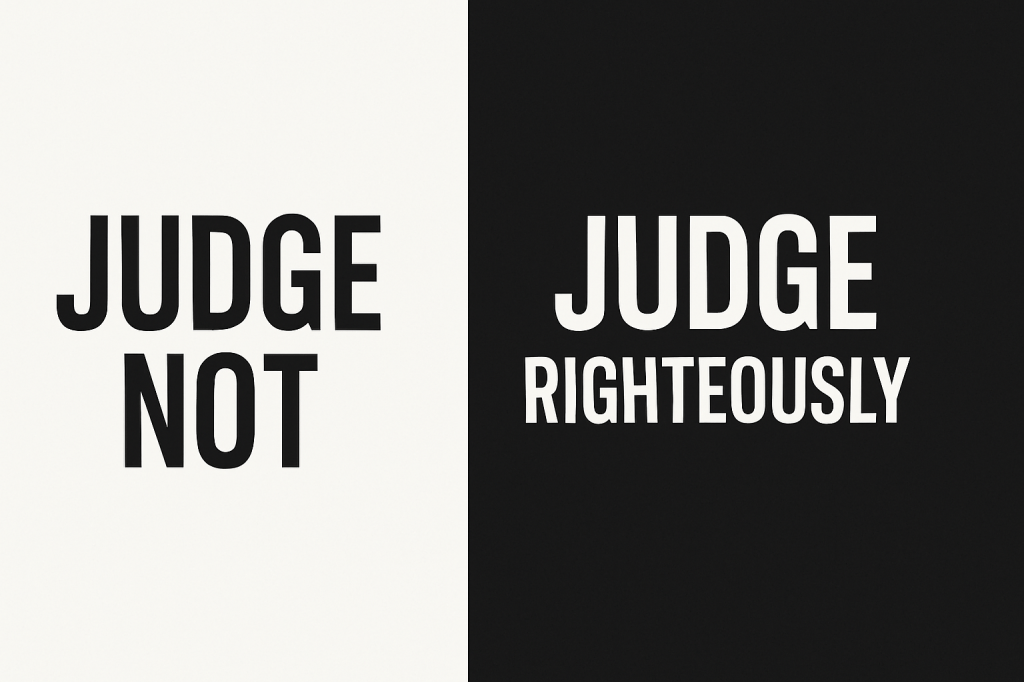
  • We’ve all heard someone quote, “Judge not,” as if Jesus was shutting down every form of discernment. But if you read what He actually said in John 7:24, you realize He wasn’t saying, “Don’t judge at all.” He was saying, don’t judge by appearances, judge with righteous judgment.

    That’s a whole different conversation.

    Judging righteously isn’t about nitpicking people or playing “spiritual cop.” It’s about learning to see with God’s eyes. It’s about discernment, not personal biases or emotions but the truth of His Word and the leading of His Spirit.

    It Starts in the House of God.

    The Bible says in 1 Peter 4:17 that judgment begins at the House of God. That means before we ever think about calling out the world, we have to start by looking in the mirror. Not in shame, but in honesty. If we belong to Jesus, we’re part of His family and He’s committed to keeping His house in order.

    Paul put it plainly in 1 Corinthians 5:12–13: “Do you not judge those who are inside? But those who are outside God judges.” In other words, God never told us to nitpick unbelievers into behaving like Christians. He told us to love them and share the gospel. But inside the Body, we hold one another accountable—because holiness matters.

    Humility First

    Here’s where Matthew 7:1–5 comes in. Jesus says to take the plank out of your own eye first, then you’ll see clearly to help your brother with his speck. That’s the whole point—clear vision starts with humble repentance.

    If I’m walking around with unaddressed sin in my own heart, I can’t see clearly enough to help anyone else. Righteous judgment begins with letting God search me, break me, and heal me.

    Why It Matters

    Righteous judgment isn’t cold, harsh, or condemning. It’s loving enough to say, “I see where this path leads, and I care too much to stay silent.” Proverbs 31:9 says, “Open your mouth, judge righteously, and plead the cause of the poor and needy.” That’s action. That’s compassion. That’s God’s heart.

    And here’s the part that makes it even more sobering: 1 Peter 4:18 says, “If the righteous one is scarcely saved, where will the ungodly and the sinner appear?” That’s not meant to make us fearful—it’s meant to wake us up. If living for God takes such grace and perseverance for those who belong to Him, how much more urgent is it for us to shine His light in a dark world?

    Training for the Kingdom

    Paul takes it even further in 1 Corinthians 6:2–3. He says the saints will judge the world—and even angels. That means the discernment we walk in today is practice for eternity. In Revelation 20:4, we see believers sitting on thrones, given authority to judge with Christ.

    This isn’t about bossing people around in heaven. It’s about ruling with the same heart as our King…perfect justice, perfect mercy, perfect love. And that starts here and now, in how we treat each other, how we handle truth, and how we let God shape our character.

    It’s okay to judge righteously.

    Righteous judgment is really about two things:

    Living under God’s judgment first letting Him deal with our hearts before we try to deal with anyone else’s. Loving enough to speak truth, not to shame, but to restore.

    We don’t judge by appearances. We don’t judge hypocritically. We judge with a heart that has been broken by grace, restored by mercy, and committed to the truth because one day, we’ll stand beside Jesus and judge with Him.

    Until then, let’s be the kind of people who walk in both truth and love, people who let God’s Word guide our discernment, who keep our own hearts pure, and who care enough to help others walk in freedom.

  • There comes a point in every true believer’s life where the hunger shifts.

    The same eyes that once scanned the world for pleasure, acceptance, and escape… start to blink open to something different—something better. And to get there, you’ve got to close your eyes.

    Close your eyes to the lies.

    Close your eyes to the praise of people.

    Close your eyes to the bottle, the blunt, the body count.

    Close your eyes to the flashing lights that promise fulfillment but leave you emptier every time.

    Because those lights? They blind you!

    And if you’re not careful, you’ll mistake the world’s glare for God’s glow. But they’re not the same.

    When someone walks into church fresh out of the world—raw, weeping, wrecked, desperate—they’re seeing clearly for the first time. Their eyes are adjusting to the light. They’re not asking for shortcuts or excuses. They’re laying it all down.

    They’re done with the drinking.

    Done with the drugs.

    Done with the hookups and the heartbreaks.

    They’ve closed their eyes to the world… and opened their hearts to Heaven.

    And what do we do?

    We try to dim the light.

    We tell them, “Don’t get too radical.”

    “God knows your heart.”

    “Just pace yourself.”

    “It’s not that deep.”

    We spoon-feed them half-truths in the name of “grace,” when really, we might be doing them more harm than good .

    We water it down.

    But here’s the truth nobody wants to say out loud:

    We are not called to blend in with the dark. We are called to shine.

    Jesus didn’t pull people out of the pit just to pat them on the back and toss them a blanket. He called them out. He told them, “Go and sin no more.”

    This isn’t legalism.

    This isn’t religion.

    This is transformation.

    “Blessed are those who hunger and thirst for righteousness, for they shall be filled.” —Matthew 5:6

    When your appetite changes, your direction does too.

    You’re no longer craving what used to numb you, you’re starving for truth. For righteousness. For Him.

    You don’t want the stage anymore; you want the secret place.

    You don’t need validation anymore; you need vision, eyes wide open to the Word of God.

    Because grace doesn’t lower the standard—it lifts you to it.

    “Do not be deceived: God is not mocked. A man reaps what he sows.” —Galatians 6:7

    “Enter through the narrow gate… only a few find it.” —Matthew 7:13–14

    “If anyone is in Christ, he is a new creation.” —2 Corinthians 5:17

    We’re not just called to believe—we’re called to become.

    So let’s stop calling compromise “grace.”

    Let’s stop confusing comfort with compassion.

    Let’s be the kind of people who help others stay free, not quietly walk them back into the darkness they begged to be rescued from.

    Because Jesus didn’t die to help us manage sin.

    He died to deliver us from it.

    Maybe it’s time we put the blinders back on

    not to live in ignorance, but to shut out the world so we can see Heaven more clearly.

  • Let’s talk real for a minute.

    Not all of us are in the same place when it comes to our walk with God. And you know what? That’s perfectly okay.

    Some folks are out there in deep waters fully surrendered, fully trusting, fully immersed in what God’s doing. Others are standing on the edge, just stepping in. And then there are those somewhere in between, testing the waters, trying to figure out what it really means to follow Jesus.

    But listen just because we’re at different places doesn’t mean anyone’s better or more spiritual than someone else. It just means we’re growing. We’re moving. And we’re not all on the same step, but we’re on the same journey.

    Heaven is the goal.

    Christlikeness is the pursuit.

    The Bible puts it this way in 2 Peter 3:18 —

    “But grow in grace, and in the knowledge of our Lord and Savior Jesus Christ.”

    That tells me we’re supposed to keep growing. It’s not a suggestion. And it’s not something we graduate from.

    The minute we think we’ve arrived that we’ve grown “enough” we’re already missing the point. That mindset isn’t truth. That’s deception. The enemy would love nothing more than for us to get comfortable and stop pressing in.

    But God? He’s always calling us deeper.

    Past the surface. Past the motions. Past the comfort zone.

    Romans 11:33 says,

    “Oh, the depth of the riches both of the wisdom and knowledge of God! How unsearchable are His judgments, and His ways past finding out!”

    We’ll never figure God out completely. There’s always more of Him to discover, more to learn, more to surrender.

    And here’s the part we don’t always like:

    Going deeper usually costs something.

    If you want to grow spiritually, you’ve got to be willing to let go of what’s keeping you stuck.

    “To be carnally minded is death; but to be spiritually minded is life and peace.” — Romans 8:6

    You can’t fill your life with spiritual power and worldly distractions at the same time. At some point, you’ve got to choose what’s staying and what’s going.

    Letting go of pride? That’s part of it.

    Laying down comfort? That too.

    Giving up that habit, that relationship, that idol? Absolutely.

    And when you do? You make more room for Him.

    “He must increase, but I must decrease.” — John 3:30

    The deeper the surrender, the deeper the anointing.

    The more we release, the more He fills.

    So wherever you find yourself right now just beginning, halfway in, or out in the deep, keep going. Don’t stop. Don’t settle for shallow. God’s not finished with you, and there is more ahead than you can imagine.

    This journey isn’t about being perfect. It’s about staying in motion, growing day by day, and keeping your eyes on Jesus.

  • These days, everything’s on display.

    Your body. Your thoughts. Your private moments.

    We’ve been taught to believe that being visible equals being real.

    But here’s the thing:

    Nudity isn’t honesty.

    And being vulnerable doesn’t mean stripping everything down for public consumption.

    Modesty isn’t some dusty rule from your grandma’s church pamphlet. It’s not about looking like you just fell off the back of a covered wagon. It’s about knowing deep down without needing applause that you were made with intention, and you don’t have to prove a thing to anyone.

    Go back to the garden. Genesis 3.

    Adam and Eve take a bite they shouldn’t have, and suddenly they’re aware they’re naked.

    Their first move? Cover up with fig leaves.

    They were trying to fix something they didn’t know how to fix.

    Then God shows up. Not with a lecture.

    But with love.

    And He says, “That fig-leaf fix you came up with? It’s not enough.”

    So He makes garments out of skin. Something real. Something lasting.

    Why?

    Because He wasn’t just covering their bodies. He was restoring their dignity.

    That moment still speaks.

    We live in a culture that cheers when you bare it all.

    But showing skin and baring your soul are not the same thing.

    Confidence isn’t loud. Real confidence whispers, “I don’t have to be on display to be enough.”

    Your body isn’t a billboard.

    Your soul isn’t a story for strangers to pick apart.

    If you belong to Christ, you’ve been bought with a price. That means something. It’s not just a verse we put on mugs and forget.

    Romans 12:1 doesn’t mince words.

    Present your body as a living sacrifice. Holy. Acceptable.

    That’s not just about what you do on Sunday it’s about how you show up in everyday life.

    Modesty is about freedom.

    Freedom from needing constant validation.

    Freedom from performing.

    Freedom to live knowing you are already seen, already loved, already claimed by the One who made you.

    So yeah, ask yourself:

    What am I really saying with what I show? Who am I trying to impress? Am I honoring the One who covered me or just trying to get noticed?

    You don’t need to be louder to be heard.

    You don’t need to reveal more to be seen.

    You don’t need to compete with filters, algorithms, or trends.

    God already sees you.

    And He says you are fearfully and wonderfully made, not because of what’s visible, but because of what’s sacred.

    Let’s bring back dignity.

    Let’s walk like people who know our worth.

    Let’s carry ourselves with quiet strength online, offline, and everywhere in between.

    Modesty isn’t about hiding.

    It’s about knowing who you are and living like you belong to Someone greater

    Whether you’re single, dating, or married if you belong to Christ, your body is sacred. You’ve been bought with a price. You are not your own (1 Corinthians 6:19–20). That means your worth doesn’t come from views, likes, or validation, it comes from the One who created you.

    Romans 12:1 calls us to “present our bodies as a living sacrifice, holy and acceptable to God.”

    That includes how we carry ourselves, online and offline.

    This isn’t about judgment, it’s about freedom.

    Freedom to stop performing.

    Freedom to stop seeking approval from a crowd that doesn’t know your value.

    Freedom to walk in modesty, not because you’re hiding but because you know who you are.

    So ask yourself today:

    What message am I sending with what I share? Am I pointing people to God or just trying to be noticed? Is this honoring the God who covers me?

    You don’t have to reveal more to be seen.

    God sees you already.

    And He says you are fearfully and wonderfully made, not because of what you show, but because of who you are in Him.

    Let’s be people who carry ourselves with purpose and dignity.

    Let’s bring back modesty from the inside out.

  • Let’s get real for a moment.

    One of the most overlooked things that can either grow your faith or sabotage it is your circle. Who are you doing life with? Who’s got your ear? Who are you letting shape your perspective, your values, your worldview?

    Because here’s the deal: influence is real, whether you notice it or not. It’s not about being judgmental. It’s about being wise. It’s not about thinking you’re better than anyone. It’s about being honest about what’s shaping your life.

    Paul said it like this:

    “Do not be misled: Bad company corrupts good character.” — 1 Corinthians 15:33 (NIV)

    That’s not just a warning it’s a fact. You can’t constantly surround yourself with people who aren’t walking with God and expect it not to impact you. You’re being shaped by your closest relationships. Your thoughts, your decisions, even your standards they’re all affected.

    Even if it doesn’t feel like it right now, it’s happening.

    That’s why the Bible says:

    “What fellowship can light have with darkness?” — 2 Corinthians 6:14 (NIV)

    It’s not saying you can’t love people who don’t believe like you. Jesus loved everybody. He ate with sinners. He showed grace. He was…is grace.

    But he never let the world shape him. He shaped the world.

    There’s a difference between being in the world and being of the world. Jesus prayed for us in John 17, saying we’re not of the world even though we’re living in it.

    You can still be kind. Still show love. Still invite people to church. But your closest circle? Your inner circle? That needs to be people who are pursuing the same God you are. People who will challenge you to grow, hold you accountable, and remind you who you are in Christ when you forget.

    Because let’s be honest the voice of the world is loud. It sounds good. Sometimes it even sounds right. But that’s the deception.

    “Satan himself masquerades as an angel of light.” — 2 Corinthians 11:14 (NIV)

    Not everything that sounds spiritual is godly. Not everything that feels right is right.

    That’s why God calls us to be set apart. Not self-righteous. Not isolated. But distinct.

    “Come out from among them and be separate,” says the Lord. — 2 Corinthians 6:17 (NIV)

    If you want to grow in your faith, really grow, it starts with who you’re walking with. Psalm 1 says the blessed person doesn’t “walk in step with the wicked” but delights in God’s Word.

    So here’s the challenge today:

    Take a look at your circle.

    Who’s building you up in your faith?

    Who’s pulling you toward Jesus and who might be pulling you away?

    And if you realize you need to make some changes don’t feel guilty. Don’t feel like you’re abandoning people. Just recognize: you’re not their Savior. That’s Jesus’ job. You’re called to love them but you’re also called to protect what God is doing in you.

    You’ve got one life.

    Guard your heart.

    Guard your faith.

    Guard your circle.

    And walk closely with the people who help you walk closely with God.


    About the Author

    Don Ramey is the founder of Grace Next-Door, a weekly blog calling believers to live boldly, love deeply, and walk in truth. He writes to stir hearts, confront compromise, and point people to Jesus.

  • by Don Ramey

    We’re living in a generation obsessed with “my truth.”

    You hear it all the time.

    That’s just my truth.

    I’m living my truth.

    This is what feels right to me.

    But what happens when your truth contradicts God’s truth?

    We’ve convinced ourselves that truth is fluid. That it can be bent, reshaped, or personalized based on how we feel, how we were raised, or what makes us feel good in the moment. But that’s not truth. That’s preference. That’s comfort. That’s ideology.

    And God didn’t call us to be comfortable. He called us to be transformed.

    In John 18, Pontius Pilate stood face to face with Jesus and asked, “What is truth?” It’s a question people are still asking today. But Pilate missed something critical Jesus had already answered that question.

    Just moments before, Jesus declared, “Everyone who is of the truth listens to My voice.”

    Truth isn’t just an idea. It’s a voice.

    And that voice has a name: Jesus.

    He didn’t say truth is whatever you want it to be. He didn’t say follow your heart, trust your instincts, or chase what makes you happy. He said, follow Me.

    There’s a dangerous lie in today’s culture that says truth should affirm you. That if it doesn’t agree with you, then it must be wrong or judgmental. But here’s the reality:

    God’s truth doesn’t conform to us.

    It confronts us.

    It convicts us.

    And ultimately, it transforms us.

    When you live by “your truth,” you seek validation. But when you live by His truth, you find salvation.

    It’s not about what feels right, it’s about what is right. And God’s Word is clear. His truth doesn’t shift. It doesn’t evolve with culture. It stands.

    That means if your version of truth allows you to keep living in sin, keep doing what you’ve always done, keep sounding like the world, acting like the world, and justifying behaviors that clearly go against God’s Word, then it’s not truth at all. It’s a counterfeit. It’s deception dressed up as freedom.

    You don’t get to rewrite the truth to match your lifestyle.

    The truth is meant to rewrite you.

    Jesus said in John 17:17, “Sanctify them by the truth; Your word is truth.”

    Real truth changes you. It sanctifies you. It pulls you out of who you used to be and shapes you into who God created you to become. That’s not always easy. It doesn’t always feel good. But it’s always worth it.

    You can’t be set free by a truth you refuse to surrender to.

    So today, stop chasing your own version of truth.

    Start listening to His voice.

    And let the truth—the real truth—set you free.